Showing posts with label Weird. Show all posts

Sunday, November 10, 2013

Volcanoes are among the Earth’s most powerful natural phenomena


The Spectacular Blood-Red Hues of Indonesia’s Mount Bromo Volcano

In nature, even the most destructive forces can be staggeringly beautiful – and nowhere is this more true than with an active volcano. Volcanoes are among the Earth’s most powerful natural phenomena: they have created mountains, laid down expansive plains and formed whole islands. Yet their eruptions have also killed people by their thousands, smothered forests and cities, and changed global weather. Still, as these incredible photographs of Mount Bromo by Helminadia Ranford show, volcanoes can be as lovely as they are mighty.

Mount Bromo is an active volcano located in the Bromo Tengger Semeru National Park in East Java, Indonesia. It forms part of the enormous Tengger Massif, which also contains Mount Sumeru, an even more highly active volcano. Indonesia itself is in the volatile Pacific “Ring of Fire,” which not only means that it experiences volcanic and tectonic activity, but also the results of such activity, like earthquakes and tsunamis.

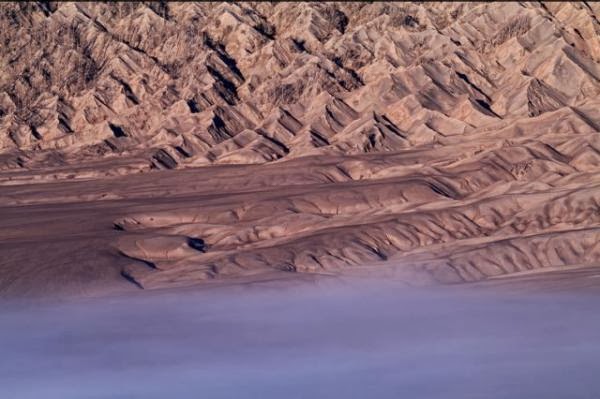
Mount Bromo, or Gunung Bromo as it is known in Indonesia, is certainly an awesome sight. It rises majestically from the surrounding Sea of Sands, and the nearby area is a desolate landscape on which flora and fauna is largely lacking. There are higher volcanoes on Java, but the 7,641-foot (2,329-meter) Mount Bromo is said to be easily the most spectacular – particularly when the light gives its volcanic smoke plume a reddish color, as these photographs show.

Over 250,000 years ago, a massive stratovolcano stood here. If it still existed, at a height of around 14,763 feet (4,500 meters) it would be the highest mountain in Java. It was the collapse of the top of this prehistoric volcano that created the sandy caldera where Mount Bromo and four other volcanoes have since formed.
There have been several eruptions from Mount Bromo in recent years. Ash plumes from one such event in late 2010 and early 2011 damaged buildings, laid waste to farmland and disrupted flights in Java. In January 2011 an 18,044-foot (5,500-meter) plume drifted as far away as the island of Bali, causing the cancellation of flights there as well. This was the biggest eruption of Mount Bromo ever recorded.<
The 2011 eruptions of Mount Bromo are thought to have been caused by especially heavy rainfall in the area. The water collected in the caldera led to what are called phreatic eruptions. These occur when magma superheats surface or ground water, making it evaporate almost instantaneously. This extremely rapid evaporation creates explosions of not only steam and water, but also rocks, ash, and lumps of molten rock known as volcanic bombs.

To the people who live around Mount Bromo, the Tenggerese, the volcano is considered sacred. The Tenggerese are one of the only groups to still practice Hinduism on Java, and they are held to be descended from Majapahit princes. The community was forced onto higher ground after the appearance of the Muslim Madurese in the 1800s, and today there are around 30 Tenggerese villages located within or near the national park.
The community also has a rich mythology. The Javanese believe that the name Tengger is derived from the names of Princess Roro Anteng, the daughter of a Majapahit King, and her spouse Joko Seger. The couple is said to have run away to Mount Bromo to escape the Madurese, and they eventually established the Tenggerese kingdom there.
The legend goes on to say that although the kingdom thrived, the rulers could not bring forth an heir. However, after many days of praying at Mount Bromo, the princess and her husband were told by the god Hyang Widi Wasa that they would be granted their wish – with the proviso that the last of their children would be sacrificed back to the volcano. In desperation, they agreed.
True to Hyang Widi Wasa’s word, Roro and Joko went on to have children – 25 of them in fact – but they could not bring themselves to sacrifice their youngest, Prince Kesuma, to the mountain as promised. Unfortunately, the god would not be denied and caused an enormous eruption of Mount Bromo that swallowed up Kesuma anyway. In order to pacify the deity, Kesuma’s siblings made offerings to the crater, a ritual that continues among the Tenggerese to this day.
Every year, the local Tenggerese bring sacrifices to the volcano during the festival of Yadnya Kasada. These offerings include flowers, fruit, vegetables and cattle, all of which are thrown into the volcano’s caldera. The ritual is organized from a temple called Pura Luhur Poten, which sits on the Sea of Sands and was built using black volcanic rock from the area.
With such stunning scenery, it’s not surprising that the national park is also a major tourist attraction. As well as the volcano, there is the unusual landscape to see around it, including the otherworldly Sea of Sands, tall cliffs and volcanic peaks. All of it is as bewitching as it is inhospitable.
Not all the land around Mount Bromo is so desolate, however. There are also zones of tropical forest containing wildlife such as rusa deer, crab-eating macaques, marbled cats and even leopards. There are also well over a hundred species of birds, including hawks and eagles.
Visitors to Mount Bromo are able to hike to the volcano, as the whole area is ideal for walking, or to climb the nearby Mount Penanjakan, which has a handy viewpoint. Bromo is said to be particularly beautiful at sunrise, when the natural light gives the mountains an ethereal quality. However, since it is an active volcano, certain areas are off-limits to tourists
Although Mount Bromo may be the most easily reached active volcano in Indonesia, there are still risks involved with exploring it too closely. Two tourists lost their lives in 2004 after rocks were thrown up owing to an abrupt explosion. Visitors are advised to check the Smithsonian Institute’s Volcanic Activity Report before they go. We thank photographer Helminadia Ranford for sharing with us her incredible photographs of this captivating and unique place.

Saturday, January 16, 2010

Most Weird Pets


Wednesday, December 31, 2008

The heart that grew back: 'Miracle' of girl whose heart healed itself after a third was removed in emergency operation

Aged four months, Kirsty Collier lay dying on the operating table with a serious heart defect.

Her surgeon had tried his best to correct the problem but thought the organ was so badly damaged that there was no hope.

As a last-ditch attempt to save Kirsty's life, he decided to cut away a third of her heart, enlarged because of her condition, in case that restarted it.

And against all the odds, it once again began to beat. For Professor Stephen Westaby, that, in itself, was a miracle. But ten years on, Kirsty's heart has proved even more of a surprise.

For it has healed itself in a way experts never thought possible, and is now the normal size and shape for a girl of her age – without a single telltale scar from the original surgery.

Kirsty was born with a rare heart condition, which is frequently fatal within the first three months of life. The defect meant that her left coronary artery, which carries blood to the heart muscle, was connected to the pulmonary artery instead of the aorta.

As a result, the organ was starved of oxygen and became enlarged. Kirsty had numerous heart attacks as a baby and her prospects seemed bleak.

As her condition became critical, Professor Westaby was called upon to carry out corrective surgery at the John Radcliffe Hospital, Oxford.

But Kirsty was linked up to a heart lung bypass machine for the surgery – and when the surgical team attempted to get the heart to take over once again, they found it was so badly damaged that it was unable to pump blood again.

'We felt there was no hope at all,' Professor Westaby told Sky News.

A message was even sent to Kirsty's parents to warn them 'it was not going well'.

'She was essentially dead and was only resurrected by what I regarded at the time as a completely bizarre operation,' added Professor Westaby.

However, the surgeon had a hunch that reducing the size of Kirsty's heart would ease the pressure on the muscle, allowing it to contract properly.

And using scissors, he removed a large section of the muscle wall, stitched it back together, and hoped for the best.

'I have to confess I never thought it would work. It was an awful lot smaller.' But the baby's heart began beating again.

Today, Kirsty, of Cirencester, Gloucestershire, is a sporty tenyear- old who plays rugby at school. 'Her recovery is miraculous,' said Professor Westaby.

Her mother, Becky, 38, said: 'She's such a sporty girl. It's hard to imagine she was ill sometimes.' Recalling her first sight of Kirsty after the operation, she added: 'There she was, my tiny baby, with tubes everywhere. They said she'd take a step forward and a step back. But I could tell by looking at her that she would keep going.

It's amazing what she has overcome. 'She's such a brave little girl but and has never let her condition affect her life at all. I think that has been behind her recovery – she doesn't think about it.'

Kirsty's father Wayne, a computer- software salesman, said: 'It was a dark day when she went in the operating theatre. It's unbelievable. She has a normal life like any other girl.'


Professor Westaby said the results of a recent MRI scan of Kirsty's heart were 'fascinating' because of the extent the heart has healed itself. 'An adult heart wouldn't do that.'

As for Kirsty, she has refused to let her early problems shape her life. 'I don't want to be different to anyone else just because I've had a heart operation,' she said.

Monday, December 22, 2008

Cat With Four Ears

Yoda The Cat With Four Ears

Saturday, November 22, 2008

The incredible territorial fight between two raging hippo bulls

Exploding out of the water with ferocious rage these giant male hippos cast a frightening sight as they fight over a water hole in South Africa.

Captured by professional guide and wildlife photographer Hendrik Fehsenfeld, in South Africa's Ngala Private Game Reserve in September, this amazing sequence of photographs show just why these one ton animals should never be crossed.

'This was the first time I had witnessed a hippo fight, so close and personal,' said Fehsenfeld, 40.
'I was giving a tour to some guests on the game viewing vehicle and we were in a sort of stunned disbelief.

'I approached with caution as aggression may divert towards the vehicle .

'When it became clear that these bulls were oblivious to our presence I crept in to get these amazing shots.'

'Looking at the photographs it seems that the bulls are of different ages,' he said.

'This can be seen by examining the condition of the teeth, in particular, the incisors and canines. The challenger appeared to be the younger of the two.'
Fehsenfeld, who has been a guide for seven years, explained that the violent encounter was the result of a territorial battle during the notoriously difficult dry season when water is scarce.

'There are many factors that play into the eruption of a serious fight; the two most common factors being territory and mating rights.

'Dominant hippo bulls do have territories which they will defend. This flight erupted when this younger bull arrived at the water-hole already occupied by the older bull, thus trespassing and ignoring him as the territory holder.

'This is equivalent of a direct challenge.'

For the safety of his group, Fehsenfeld only watched the encounter for a few minutes, but returned the following day to see who had claimed the territory.
'The next morning the old bull was gone. I and tracker Norman found his tracks leaving the water-hole with a blood trail,' he recalled.

'We followed it until the vegetation got very thick - it's not wise to follow an injured animal into thick vegetation.

'So maybe he recovered, maybe he found an unoccupied water-hole. Maybe he lay down in the soothing shade and drifted off. There was no increase in vulture or hyena activity in the area, so perhaps he made it!'

Thursday, November 20, 2008

The World’s Smallest Horses

A couple of years ago the UK’s Daily Mail reported on the world’s smallest horse, Thumbelina, who entered the Guinness Book of Records measuring just 17 inches tall.

Born in a farm in America where the owners specialise in breeding miniature horses, the couple realised that Thumbelina was different as soon as she was born because she weighed a mere 8lbs, the average weight of a new born human baby.

The breeders, Kay and Paul Goessling, although under scrutiny from a sceptical public who questioned their breeding practices, claimed that the tiny horse suffers from dwarfism, something they will be certain doesn’t carry through the gene pool.

Now, in Britain, another tiny trotter has hit the headlines. Four-year-old Lucy, a Shetland pony weighing around 100 Ibs and measuring 19.5 inches has claimed the title of Britain’s smallest horse. Only this time she’s a true miniature mare.
Lucy is owned by veterinary surgeon Sandra Power, who is unclear why the pony didn’t grow much bigger – she stopped growing when she reached the age of two.

Ms Power told the Telegraph newspaper: “I wasn’t expecting Lucy to be so small. She was about 15 inches when I got her at three months – that’s a normal size for a Shetland foal.”

According to her owner, Lucy is perfectly proportioned, apart from her mane and tail, which grow at an alarming rate.

Lucy lives in custom-made stables with a door that is only 21 inches high – something that would put a kid’s Wendy house to shame.

Monday, November 10, 2008

The Great Bromley Reef... coral marvel created in a garden shed

These stunning corals look like they belong in the tropical waters of the Great Barrier Reef or in the azure seas of the Caribbean.

But a closer inspection of these living rocks reveals they are actually residing in the colder climate of southern England, namely in the garden shed of a London home

Bred by 'Reef Farmer' Clayton Smith, they are part of the home-grown coral farm craze that is catching on in the UK.
His revolutionary coral farming techniques have made it possible to own a small piece of the tropics.

'Coral is an incredible pet to own,' the marine biologist said.

'The growth in coral farms and farmers is similar to the boom in tropical fish in the 60's and 70's.

'Except corals are just that little bit more spectacular in their appearance than some of the fish that people keep.'

Cut from sustainable coral that exists in the wild, Mr Smith has spent the past ten years and more than £2,500 perfecting his growth techniques.

He grows more than 120 different species in his intensive back garden lab in Bromley, South London, catering for the estimated 600,000 or so coral enthusiasts in the UK and worldwide.
'People generally have a personal taste for their aquariums and they might want soft corals, which are wavy, or they might want the large polyp stone corals which are big and fleshy.

'However, the really popular corals amongst first time farmers are the corals which glow in the dark. They definitely have the wow factor, especially if your coral tank is displayed well.'

Obsessed with the sea since he received his first fish tank at seven years old, Mr Smith has spent most of his adult life in conservation and marine study.

His work has taken him to Australia to work for the Great Barrier Reef Marine Park Authority and to the endangered reefs of the Philippines.

Mr Smith advises that anyone wanting to take on a coral farm must realise how difficult it is to care for as well as the moral implications that come from taking on a living creature.

'Keeping corals is becoming a lot easier, because the industry has come along so much in the past five years,' he said.

'However, corals need perfect conditions and total dedication in terms of the right algae as food, nutrients in the water and temperature.'.

A start-up kit for a coral farm costs as little as £13 for one two inch piece of coral, but that piece given time will blossom.

Intricate and complicated to grow and care for, coral farms require the care and attention of a bonsai tree.

Thursday, October 30, 2008

The pelican that tried to eat the dog who stole his supper

Ever heard the one about the dog and the pelican? In one of the most unlikely power struggles of the animal kingdom, these extraordinary images show the moment when a one-year-old exotic bird bit off more than it could chew.

Captured by Roland Adam at his exotic bird farm in Germany, they show how Petri the pelican and Katijina the Rhodesian Ridgeback played out an improbable contest for a free meal.

'I was preparing food for the birds in our outdoor kitchen, when I noticed Petri at my side looking for a snack,' explained 38-year-old Roland.

'I decided to feed her one of the chicks I had been preparing when Katjinga raced in, caught the frozen bird mid-air and gobbled up Petri's dinner.'

Confused and slightly miffed at losing out on a free meal, Petri decided to search every inch of Katjinga in search of the discarded chick.

'It was hilarious,' laughs Roland.

'We have so many animals on the farm that they are very tame and at ease with each other.

'Katijinga is no different and she was more than happy to allow Petri to come in for closer inspection.'

Roland, who runs an exotic bird farm in Hoerstel near Osnabrueck, which houses everything from ostriches to flamingos, said: "You see a lot of things on my farm but I have never seen anything like this before and I just had to get my camera to prove it was real,' he says.

'But I suppose when it came down to it, Katijinga was just too quick!'

Wednesday, October 29, 2008

Wildlife 'dying out at fastest rate since the dinosaurs' because of human impact on planet

Mankind is responsible for the greatest extinction of wildlife since the end of the dinosaurs, conservationists have said.

Their warning came after a report revealed that populations of animals and plants have plummeted by a third over the last 35 years as a result of hunting, overfishing, habitat destruction and the changing climate.

Humans are increasingly living beyond their means and the world is heading for an 'ecological credit crunch', according to the Living Planet Report.
Prepared by the World Wide Fund for Nature and the Zoological Society of London, the report is designed to be a health check for the Earth.

It looked at the fortunes of 1,686 species of animal and plant since the 1970s, based on around 5,000 ongoing monitoring projects.

The report found that populations of all the species fell by 30 per cent between 1970 and 2005.

The number of land animals fell by a quarter between 1970 and 2005, while freshwater animals were down by 29 per cent.

Mark Wright, of WWF, said: 'The report shows that populations are dramatically declining. There is no doubt we are in a period of mass extinction comparable to those from millions of years ago.'
Dinosaurs were wiped out 65million years ago when a comet crashed into the Gulf of Mexico sending dust into the atmosphere that blocked out the sun.

As well as charting the decline of species, the report looked at each country's 'ecological footprint' - the amount of land and sea it needs to provide its natural resources and absorb its waste.

WWF said that if pressure on water, land and wildlife and the output of carbon emissions continue to rise at the current rate, we will need two planets by the 2030s to maintain our lifestyles.

Jonathan Loh, of the ZSL, said: 'We are acting ecologically in the same way as financial institutions have been behaving economically - seeking immediate gratification without due regard for the consequences.'
 

Somethin Precious l Illusions | Amazing Facts Copyright © 2009 DarkfolioZ is Designed by Bie Blogger Template for Ipietoon
In Collaboration With fifa