The Spectacular Blood-Red Hues of Indonesia’s Mount Bromo Volcano
In nature, even the most destructive forces can be staggeringly beautiful – and nowhere is this more true than with an active volcano. Volcanoes are among the Earth’s most powerful natural phenomena: they have created mountains, laid down expansive plains and formed whole islands. Yet their eruptions have also killed people by their thousands, smothered forests and cities, and changed global weather. Still, as these incredible photographs of Mount Bromo by Helminadia Ranford show, volcanoes can be as lovely as they are mighty.
Mount Bromo is an active volcano located in the Bromo Tengger Semeru National Park in East Java, Indonesia. It forms part of the enormous Tengger Massif, which also contains Mount Sumeru, an even more highly active volcano. Indonesia itself is in the volatile Pacific “Ring of Fire,” which not only means that it experiences volcanic and tectonic activity, but also the results of such activity, like earthquakes and tsunamis.
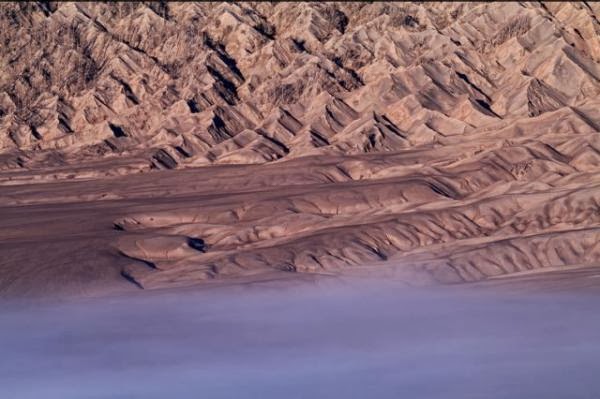
Mount Bromo, or Gunung Bromo as it is known in Indonesia, is certainly an awesome sight. It rises majestically from the surrounding Sea of Sands, and the nearby area is a desolate landscape on which flora and fauna is largely lacking. There are higher volcanoes on Java, but the 7,641-foot (2,329-meter) Mount Bromo is said to be easily the most spectacular – particularly when the light gives its volcanic smoke plume a reddish color, as these photographs show.
Over 250,000 years ago, a massive stratovolcano stood here. If it still existed, at a height of around 14,763 feet (4,500 meters) it would be the highest mountain in Java. It was the collapse of the top of this prehistoric volcano that created the sandy caldera where Mount Bromo and four other volcanoes have since formed.
There have been several eruptions from Mount Bromo in recent years. Ash plumes from one such event in late 2010 and early 2011 damaged buildings, laid waste to farmland and disrupted flights in Java. In January 2011 an 18,044-foot (5,500-meter) plume drifted as far away as the island of Bali, causing the cancellation of flights there as well. This was the biggest eruption of Mount Bromo ever recorded.<
The 2011 eruptions of Mount Bromo are thought to have been caused by especially heavy rainfall in the area. The water collected in the caldera led to what are called phreatic eruptions. These occur when magma superheats surface or ground water, making it evaporate almost instantaneously. This extremely rapid evaporation creates explosions of not only steam and water, but also rocks, ash, and lumps of molten rock known as volcanic bombs.
To the people who live around Mount Bromo, the Tenggerese, the volcano is considered sacred. The Tenggerese are one of the only groups to still practice Hinduism on Java, and they are held to be descended from Majapahit princes. The community was forced onto higher ground after the appearance of the Muslim Madurese in the 1800s, and today there are around 30 Tenggerese villages located within or near the national park.
The community also has a rich mythology. The Javanese believe that the name Tengger is derived from the names of Princess Roro Anteng, the daughter of a Majapahit King, and her spouse Joko Seger. The couple is said to have run away to Mount Bromo to escape the Madurese, and they eventually established the Tenggerese kingdom there.
The legend goes on to say that although the kingdom thrived, the rulers could not bring forth an heir. However, after many days of praying at Mount Bromo, the princess and her husband were told by the god Hyang Widi Wasa that they would be granted their wish – with the proviso that the last of their children would be sacrificed back to the volcano. In desperation, they agreed.
True to Hyang Widi Wasa’s word, Roro and Joko went on to have children – 25 of them in fact – but they could not bring themselves to sacrifice their youngest, Prince Kesuma, to the mountain as promised. Unfortunately, the god would not be denied and caused an enormous eruption of Mount Bromo that swallowed up Kesuma anyway. In order to pacify the deity, Kesuma’s siblings made offerings to the crater, a ritual that continues among the Tenggerese to this day.
Every year, the local Tenggerese bring sacrifices to the volcano during the festival of Yadnya Kasada. These offerings include flowers, fruit, vegetables and cattle, all of which are thrown into the volcano’s caldera. The ritual is organized from a temple called Pura Luhur Poten, which sits on the Sea of Sands and was built using black volcanic rock from the area.
With such stunning scenery, it’s not surprising that the national park is also a major tourist attraction. As well as the volcano, there is the unusual landscape to see around it, including the otherworldly Sea of Sands, tall cliffs and volcanic peaks. All of it is as bewitching as it is inhospitable.
Not all the land around Mount Bromo is so desolate, however. There are also zones of tropical forest containing wildlife such as rusa deer, crab-eating macaques, marbled cats and even leopards. There are also well over a hundred species of birds, including hawks and eagles.
Visitors to Mount Bromo are able to hike to the volcano, as the whole area is ideal for walking, or to climb the nearby Mount Penanjakan, which has a handy viewpoint. Bromo is said to be particularly beautiful at sunrise, when the natural light gives the mountains an ethereal quality. However, since it is an active volcano, certain areas are off-limits to tourists
Although Mount Bromo may be the most easily reached active volcano in Indonesia, there are still risks involved with exploring it too closely. Two tourists lost their lives in 2004 after rocks were thrown up owing to an abrupt explosion. Visitors are advised to check the Smithsonian Institute’s Volcanic Activity Report before they go.
We thank photographer Helminadia Ranford for sharing with us her incredible photographs of this captivating and unique place.