Sunday, November 10, 2013

Volcanoes are among the Earth’s most powerful natural phenomena


The Spectacular Blood-Red Hues of Indonesia’s Mount Bromo Volcano

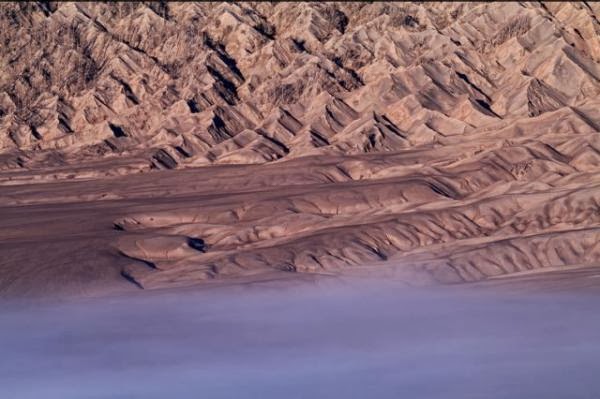
In nature, even the most destructive forces can be staggeringly beautiful – and nowhere is this more true than with an active volcano. Volcanoes are among the Earth’s most powerful natural phenomena: they have created mountains, laid down expansive plains and formed whole islands. Yet their eruptions have also killed people by their thousands, smothered forests and cities, and changed global weather. Still, as these incredible photographs of Mount Bromo by Helminadia Ranford show, volcanoes can be as lovely as they are mighty.

Mount Bromo is an active volcano located in the Bromo Tengger Semeru National Park in East Java, Indonesia. It forms part of the enormous Tengger Massif, which also contains Mount Sumeru, an even more highly active volcano. Indonesia itself is in the volatile Pacific “Ring of Fire,” which not only means that it experiences volcanic and tectonic activity, but also the results of such activity, like earthquakes and tsunamis.

Mount Bromo, or Gunung Bromo as it is known in Indonesia, is certainly an awesome sight. It rises majestically from the surrounding Sea of Sands, and the nearby area is a desolate landscape on which flora and fauna is largely lacking. There are higher volcanoes on Java, but the 7,641-foot (2,329-meter) Mount Bromo is said to be easily the most spectacular – particularly when the light gives its volcanic smoke plume a reddish color, as these photographs show.

Over 250,000 years ago, a massive stratovolcano stood here. If it still existed, at a height of around 14,763 feet (4,500 meters) it would be the highest mountain in Java. It was the collapse of the top of this prehistoric volcano that created the sandy caldera where Mount Bromo and four other volcanoes have since formed.
There have been several eruptions from Mount Bromo in recent years. Ash plumes from one such event in late 2010 and early 2011 damaged buildings, laid waste to farmland and disrupted flights in Java. In January 2011 an 18,044-foot (5,500-meter) plume drifted as far away as the island of Bali, causing the cancellation of flights there as well. This was the biggest eruption of Mount Bromo ever recorded.<
The 2011 eruptions of Mount Bromo are thought to have been caused by especially heavy rainfall in the area. The water collected in the caldera led to what are called phreatic eruptions. These occur when magma superheats surface or ground water, making it evaporate almost instantaneously. This extremely rapid evaporation creates explosions of not only steam and water, but also rocks, ash, and lumps of molten rock known as volcanic bombs.

To the people who live around Mount Bromo, the Tenggerese, the volcano is considered sacred. The Tenggerese are one of the only groups to still practice Hinduism on Java, and they are held to be descended from Majapahit princes. The community was forced onto higher ground after the appearance of the Muslim Madurese in the 1800s, and today there are around 30 Tenggerese villages located within or near the national park.
The community also has a rich mythology. The Javanese believe that the name Tengger is derived from the names of Princess Roro Anteng, the daughter of a Majapahit King, and her spouse Joko Seger. The couple is said to have run away to Mount Bromo to escape the Madurese, and they eventually established the Tenggerese kingdom there.
The legend goes on to say that although the kingdom thrived, the rulers could not bring forth an heir. However, after many days of praying at Mount Bromo, the princess and her husband were told by the god Hyang Widi Wasa that they would be granted their wish – with the proviso that the last of their children would be sacrificed back to the volcano. In desperation, they agreed.
True to Hyang Widi Wasa’s word, Roro and Joko went on to have children – 25 of them in fact – but they could not bring themselves to sacrifice their youngest, Prince Kesuma, to the mountain as promised. Unfortunately, the god would not be denied and caused an enormous eruption of Mount Bromo that swallowed up Kesuma anyway. In order to pacify the deity, Kesuma’s siblings made offerings to the crater, a ritual that continues among the Tenggerese to this day.
Every year, the local Tenggerese bring sacrifices to the volcano during the festival of Yadnya Kasada. These offerings include flowers, fruit, vegetables and cattle, all of which are thrown into the volcano’s caldera. The ritual is organized from a temple called Pura Luhur Poten, which sits on the Sea of Sands and was built using black volcanic rock from the area.
With such stunning scenery, it’s not surprising that the national park is also a major tourist attraction. As well as the volcano, there is the unusual landscape to see around it, including the otherworldly Sea of Sands, tall cliffs and volcanic peaks. All of it is as bewitching as it is inhospitable.
Not all the land around Mount Bromo is so desolate, however. There are also zones of tropical forest containing wildlife such as rusa deer, crab-eating macaques, marbled cats and even leopards. There are also well over a hundred species of birds, including hawks and eagles.
Visitors to Mount Bromo are able to hike to the volcano, as the whole area is ideal for walking, or to climb the nearby Mount Penanjakan, which has a handy viewpoint. Bromo is said to be particularly beautiful at sunrise, when the natural light gives the mountains an ethereal quality. However, since it is an active volcano, certain areas are off-limits to tourists
Although Mount Bromo may be the most easily reached active volcano in Indonesia, there are still risks involved with exploring it too closely. Two tourists lost their lives in 2004 after rocks were thrown up owing to an abrupt explosion. Visitors are advised to check the Smithsonian Institute’s Volcanic Activity Report before they go. We thank photographer Helminadia Ranford for sharing with us her incredible photographs of this captivating and unique place.

Monday, January 24, 2011

Earth 'to get second sun' as supernova turns night into day

The Earth could soon have a second sun, at least for a week or two.

The cosmic phenomenon will happen when one of the brightest stars in the night sky explodes into a supernova.

And, according to a report yesterday, the most stunning light show in the planet’s history could happen as soon as this year.
Earth will undoubtedly have a front row seat when the dying red supergiant star Betelgeuse finally blows itself into oblivion.

The explosion will be so bright that even though the star in the Orion constellation is 640 light-years away, it will still turn night into day and appear like there are two suns in the sky for a few weeks.

The only real debate is over exactly when it will happen.

In stellar terms, Betelgeuse is predicted to crash and burn in the very near future. But that doesn’t necessarily mean you have to rush out and buy sunglasses.

Brad Carter, Senior Lecturer of Physics at the University of Southern Queensland in Australia, claimed yesterday that the galactic blast could happen before 2012 – or any time over the next million years.

‘This old star is running out of fuel in its centre,’ Dr Carter told te Austalian website news.com.au.

‘This fuel keeps Betelgeuse shining and supported. When this fuel runs out the star will literally collapse in upon itself and it will do so very quickly.

‘This is the final hurrah for the star. It goes bang, it explodes, it lights up - we’ll have incredible brightness for a brief period of time for a couple of weeks and then over the coming months it begins to fade and then eventually it will be very hard to see at all,’ he added.
The Internet is abuzz with doomsday theories linking the supernova to the Mayan calendar’s prediction of an Armageddon in 2012, fuelled by the association of the word ‘Betelgeuse’ with the devil.

But experts claimed that even if the big bang is looming, it will still happen way too far from Earth to do us any harm.

‘When a star goes bang, the first we will observe of it is a rain of tiny particles called nuetrinos,’ said Dr Carter.

‘They will flood through the Earth and bizarrely enough, even though the supernova we see visually will light up the night sky, 99% of the energy in the supernova is released in these particles that will come through our bodies and through the Earth with absolutely no harm whatsoever.’

When it happens, the Betelgeuse supernova will almost certainly be the most dramatic ever seen.

It is the ninth brightest star in the night sky and the second brightest in the constellation of Orion, outshining its neighbour Rigel – or Beta Orionis – only very rarely.

It’s distinct orange-red colour makes it easy to spot in the night sky.

If it was at the centre of our solar system, its surface would extend past the asteroid belt, wholly engulfing Mercury, Venus, Mars and the Earth.

Friday, January 14, 2011

Getting down to the nitty-gritty: Amazing microscopic images of household objects

They're innocuous objects that are dotted around every home.

But when brought to life under a powerful microscope their hidden secrets are revealed - and it doesn't always make for comfortable viewing.

Scientists captured these stunningly detailed pictures using Scanning Electron Microscopes (SEMs).

The images are of items found in various domestic settings, from the bathroom to the kitchen.

A mascara brush looks like you'd imagine it to under extreme magnification, but a section of used dental floss is rather unsettling despite its bright colouration.

Elsewhere, every tiny contour of salt and ground pepper corns is revealed in extraordinary detail.
SEMs work by bombarding the object with electrons and then build extreme close-ups of the image using a computer and transmission electro microscopes.

The images are produced in monochrome and then hand-tinted to enrich their detail.

SEMs are far more powerful than regular light microscopes that can only magnify by up to 1,000 times.


Retired scientific photographer Steve Gschmeissner is grateful that he still has access to an SEM - their high price tag makes them unaffordable to all but the most wealthy enthusiast.

Mr Gschmeissner, from Bedford, said: 'For anyone involved in microscopy the SEM is the ultimate boy's toy.

'Costing between £150,000 and £500,000, there are only a handful of people around the world who have access to this for fun. To be able to use equipment like this when I am retired is a dream come true.

'The SEM picks up basically where the normal light microscope finishes. And it takes it so much further by magnifying the specimen by up to a million times.

'Also different to a regular microscope is the fact the SEM builds a 3D image giving you a unique view.'


Thursday, January 13, 2011

The gaint skeleton found under the ground of the desert in India.

The giant skeleton was excavated in the little-known part of the desert in India.


Monday, January 10, 2011

Behold! The Fearsome Knight on an Iron Horse... or rather, 500 Horses

Earlier this year (see Part 1), we examined some of the cool, the fascinating, the unusual and the utterly weird designs for motorcycles that have appeared for over the last century or so. Here’s another look the wild and wonderful world of motorcycles.

Brough Superior motorcycles were made in Nottingham, England from 1919 until 1940 and were known as ‘the Rolls Royce of motorcycles’. Very expensive at the time, they were available only to the wealthy. This model dates from 1931.
T. E. Lawrence, better known as Lawrence of Arabia, owned several of these machines and died from his injuries after crashing on one in 1935... Another beautiful bike is this Imme (Germany), with a single side suspension:
The Megola motorcycle was produced in Munich in the 1920’s. Some 2000 were built, but only 10 fully working examples are still in existence, one of which is in the Guggenheim Museum in New York:
In 1935, the Killinger and Freund motorcycle was an attempt to make an improved version of the Megola, but the advent of World War Two put an end to any further development:

Some sources point out that "in 1940, when Indian's skirted fenders appeared, several questioned the manhood of Spingfield's designers". It seems that aerodynamic shape of Killinger & Freund bikes influenced the Indian designers:
This streamlined torpedo is the French-made Majestic, 1929:
Speaking about "Custom War Bikes", here is one that was fashioned after World War Two style (modern concept by Kogisama):

The previous wild concept was not so wild, after all - take a look at the real WW2-period 1936 BMW Schneekrad
Another front-wheel tracked motorcycle prototype from 1937
Modern all-terrain tracked version is proposed by Hyanide & Baal:
After the war, the Moto Guzzi 500 cc V8 race bike was seen on the world’s high-speed racetracks from 1955 to 1957.

Modern version of the hubless wheel can be seen in the recent concepts for Harley Davidson, by designer Miguel Cotto
Many of us remember the lightcycles from the 1982 movie Tron. The long awaited sequel, Tron Legacy, is set to hit theatres in late 2010 and will feature this splendid looking specimen:
Swordfish concept chopper:
Rats & Kustoms

This custom built motorcycle, called Iceman II, was made by Walz Hardcore Choppers of Germany for Formula One world champion Kimi Raikonnen:
Rat bikes are usually defined as motorcycles that are decades old, in a poor state of repair, but still maintained and kept roadworthy by their owners on a shoestring budget. Survival bikes do resemble rat bikes and the two are often confused, although survival bikes are usually modified in much the same way that cars are customized. Here are some great examples of both of these types of machines.

Imagine seeing this coming up behind you in your rear view mirror (below left)? On the right is the rounded green beauty, also seen at the Sturgis Motorcycle Rally:
Not sure what kind of a view you’d get of the road ahead on this one (image below left)? On the right you can see a really inventive fuel tank -


On the left image below is The Survival Bike from some sort of Zombie Apocalypse... Whereas the owners of the bike (below right) decided to actually attach the coffin as a sidecar:


We featured what we had speculated might be the world’s largest motorcycle in Magnificent Motorcycles Part One, but the biggest one on the planet may actually be this one.
This bike is pretty big too and apparently this machine, called the Gunbus, is perfectly capable of being taken out on the road.

Want to travel in style? Why not try this Harley Davidson and limousine combination?
Concept Beasts

Finally, here’s a selection of concept motorcycles, which may or may not see the light of day at some point in the future. Here’s the Akira concept bike:
FuturA was designed by Mario Malagrino of the Florence Design Academy (left)... Romanian 3D artist Adrian Baluta created this cool bike called Darklight (right):
Above image, bottom row: the Suzuki Biplane and the Victory Vision 800 concept bike produced by Victory, a division of Polaris ATV's.

William Woods designed the Fallout concept motorcycle in 2009 (below left). The Wrath concept (below right) by Alexander Barnard is dubbed a ‘future modern retro chopper’ for the year 2083:

So there you are, another look at cool, fascinating, unusual and weird motorcycles from around the world. Stay tuned for more from the wild and wonderful world of these magnificent machines in future

Source
 

Somethin Precious l Illusions | Amazing Facts Copyright © 2009 DarkfolioZ is Designed by Bie Blogger Template for Ipietoon
In Collaboration With fifa